
 Why KEEP Is Different
KEEP is portfolio architecture software for long-term investors.
Local-first. Structure-aware. Discipline-focused.
KEEP does not replace your brokerage. It models what brokerages don't: structure.
Most platforms report balances. KEEP models capital architecture — allocation intent, sleeve design, category exposure, and drift across accounts and entities.
It helps you answer:
- What role does this capital serve?
- Is it behaving as intended?
- How has structure changed over time?
- Why did I make this decision?
Your data lives locally. Exports are human-readable. Analysis is inspectable.
No aggregation games. No trading dopamine. No custody risk.
Built for investors who think in decades — not days.
If you think in decades, KEEP is built for you.
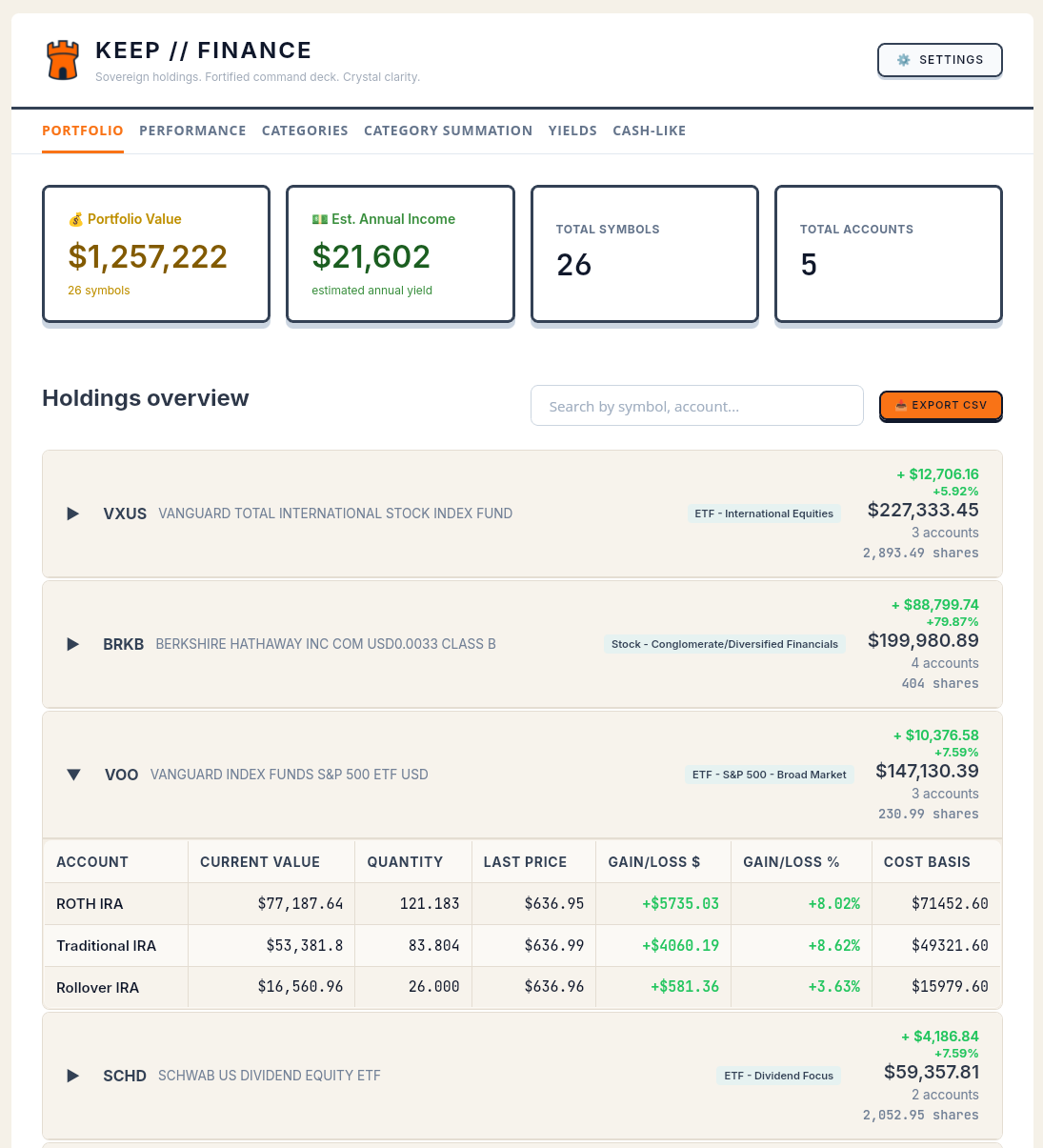
Portfolio Overview
The Portfolio view gives you a single, unified picture of your entire Fidelity portfolio across all accounts. Instead of switching between logins or reconciling spreadsheets, KEEP Finance aggregates your holdings into one clear dashboard.
Total value, estimated annual income, number of symbols, and accounts at a glance. It's designed to answer the most basic but most important question quickly: what do I actually own, and how much is it worth right now?
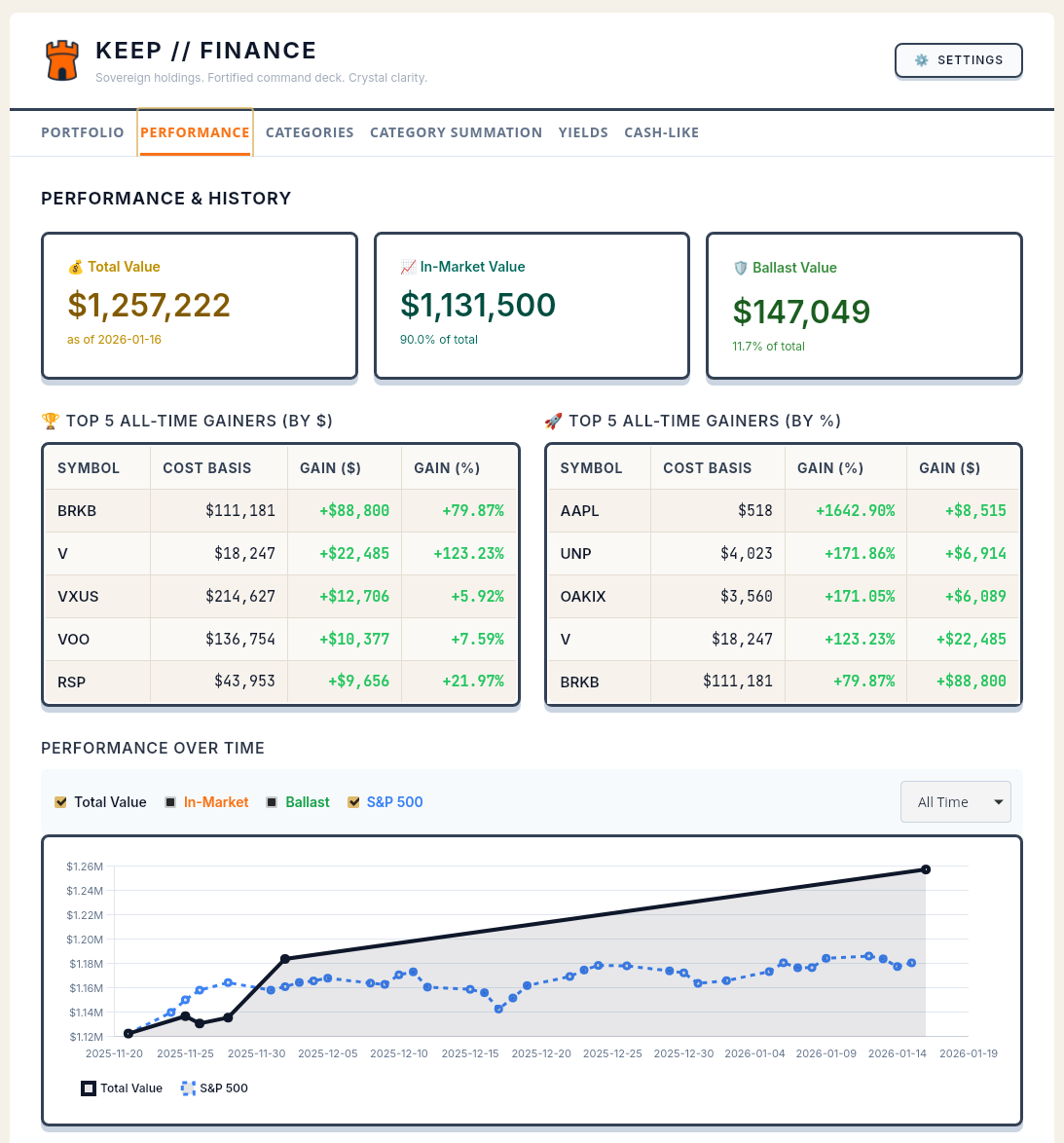
Performance & History
The Performance view focuses on long-term clarity, not trading noise. You can see total portfolio growth over time, compare in-market assets versus ballast, and benchmark against the S&P 500 to understand relative performance.
Instead of chasing daily fluctuations, this screen helps you evaluate whether your strategy is working and how different parts of your portfolio contribute to overall results — so outcomes can be reviewed in the context of the decisions that produced them.
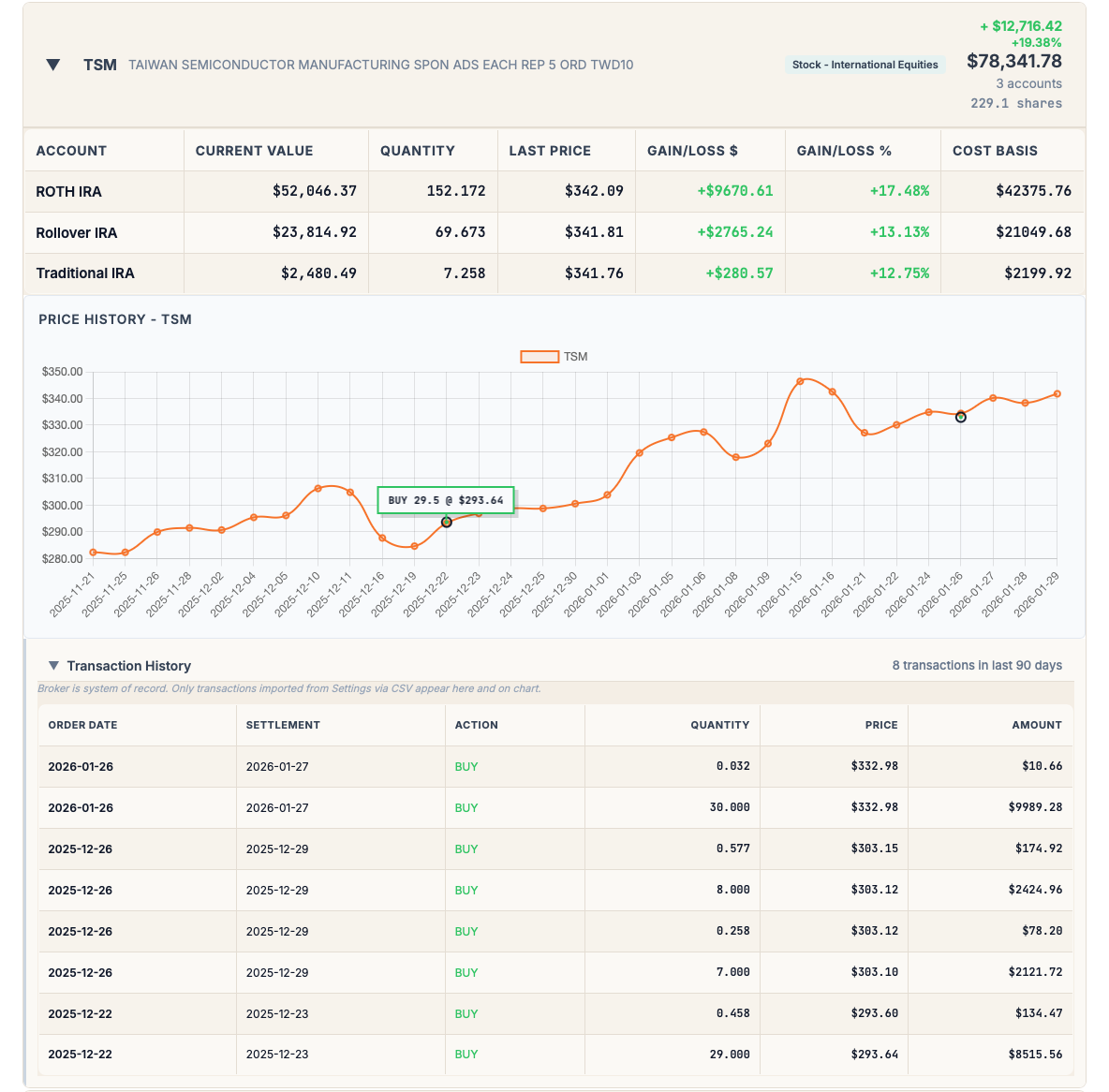
Timeline of Capital Decisions
This view records when and how capital was committed — not just how price moved. Each marker anchors a decision in time and market context, helping you review performance through the lens of judgment, not just outcome.
Combined with the transaction history below, you can see exactly what you bought, when you bought it, and at what price — giving you the full context to evaluate your decisions over time. This makes it easier to spot thesis drift — when positions persist even though the original reason for owning them has quietly changed.
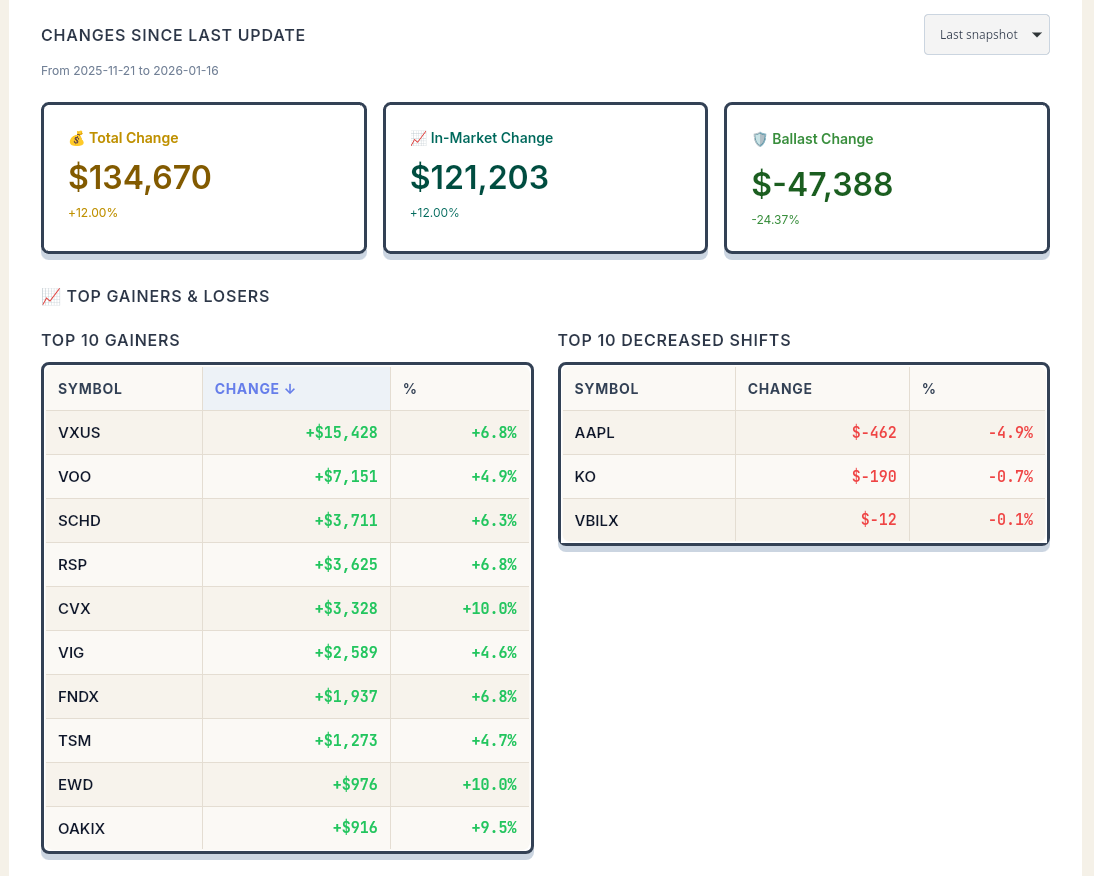
Performance Since Last Snapshot
This view shows how your portfolio has changed between two points in time — highlighting total gains, in-market movement, ballast changes, and the specific holdings driving those shifts.
Instead of raw price noise, this view focuses on what actually moved the needle: which positions gained, which declined, and where capital was added or reduced. It's designed to support periodic review and intentional decision-making, not constant monitoring.
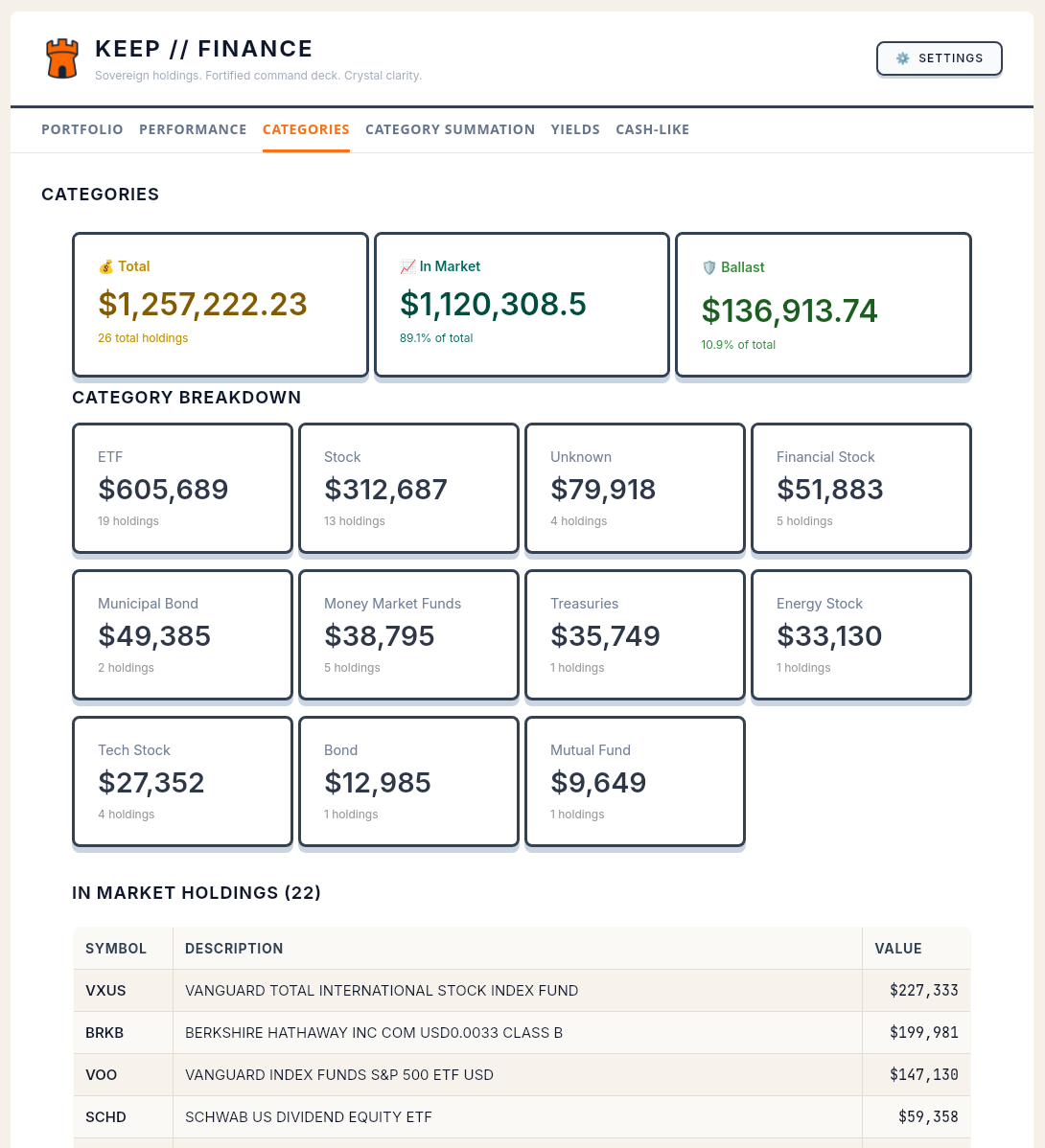
Categories Breakdown
The Categories view shows how your portfolio is actually allocated by asset type, sector, and role. ETFs, individual stocks, bonds, money market funds, and specialty holdings are grouped visually so you can immediately spot concentration, imbalance, or unintended exposure.
This view makes diversification tangible, especially for portfolios spread across multiple Fidelity accounts.
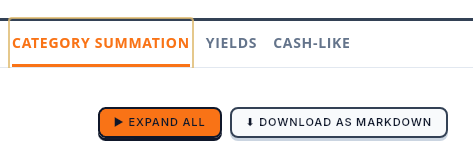
Category Summation ✨ AI-Ready Export
The Category Summation view is where KEEP Finance becomes a thinking tool. It rolls up holdings into structured categories and sub-types, then allows you to export the entire breakdown as clean, structured Markdown.
This export is intentionally formatted for use with AI tools like ChatGPT or Claude, so you can ask higher-level questions about risk, overlap, rebalancing, or strategy — while staying fully in control of what data you share.
You export what you want. You paste it yourself. You maintain control.
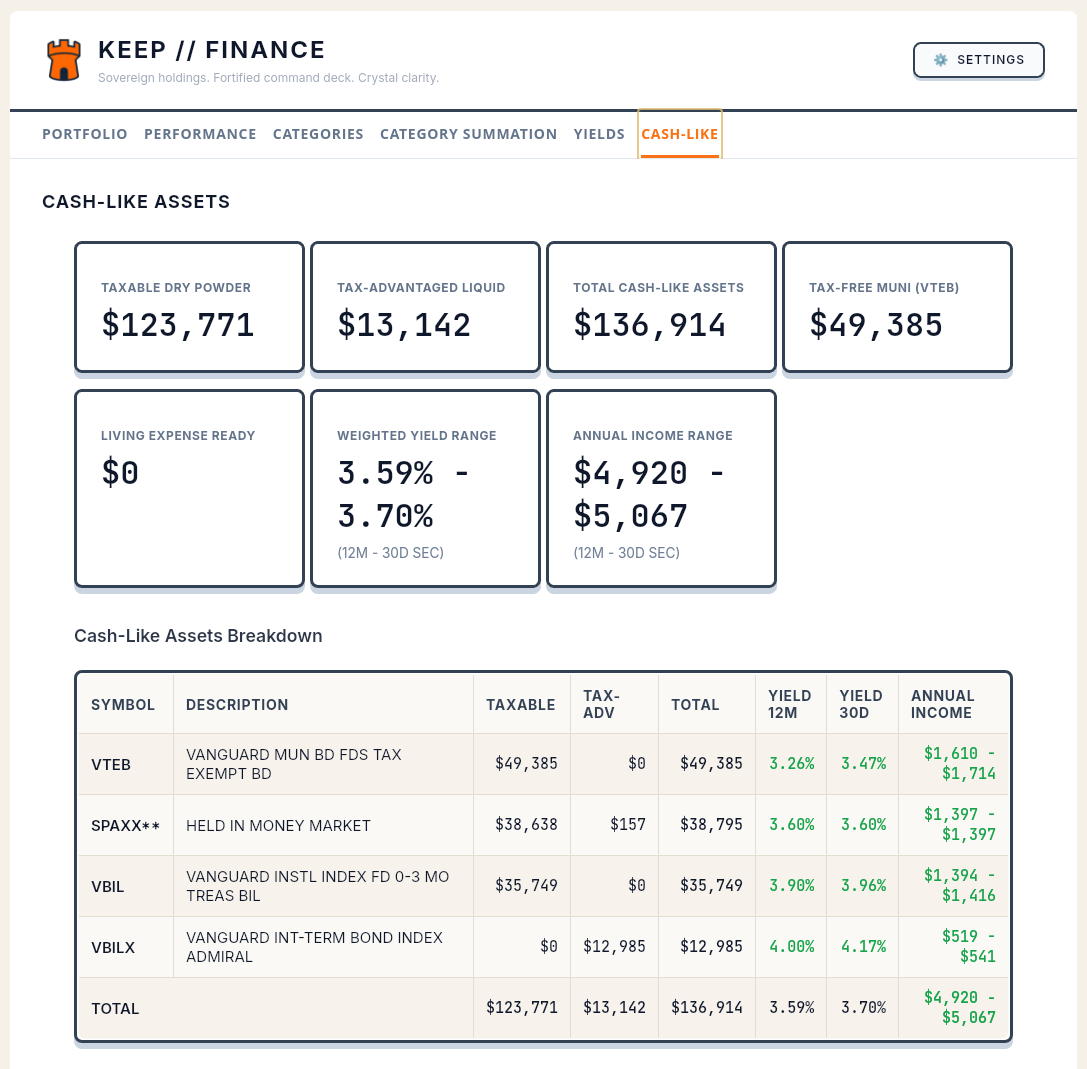
Cash-Like & Ballast Assets
The Cash-Like view isolates your most conservative assets — money market funds, short-term treasuries, municipal bonds, and other ballast holdings.
It shows taxable vs tax-advantaged liquidity, weighted yield ranges, and estimated annual income so you can understand how much dry powder you have and what it's earning.
This screen is especially useful for planning expenses, rebalancing risk, or preparing for market volatility.
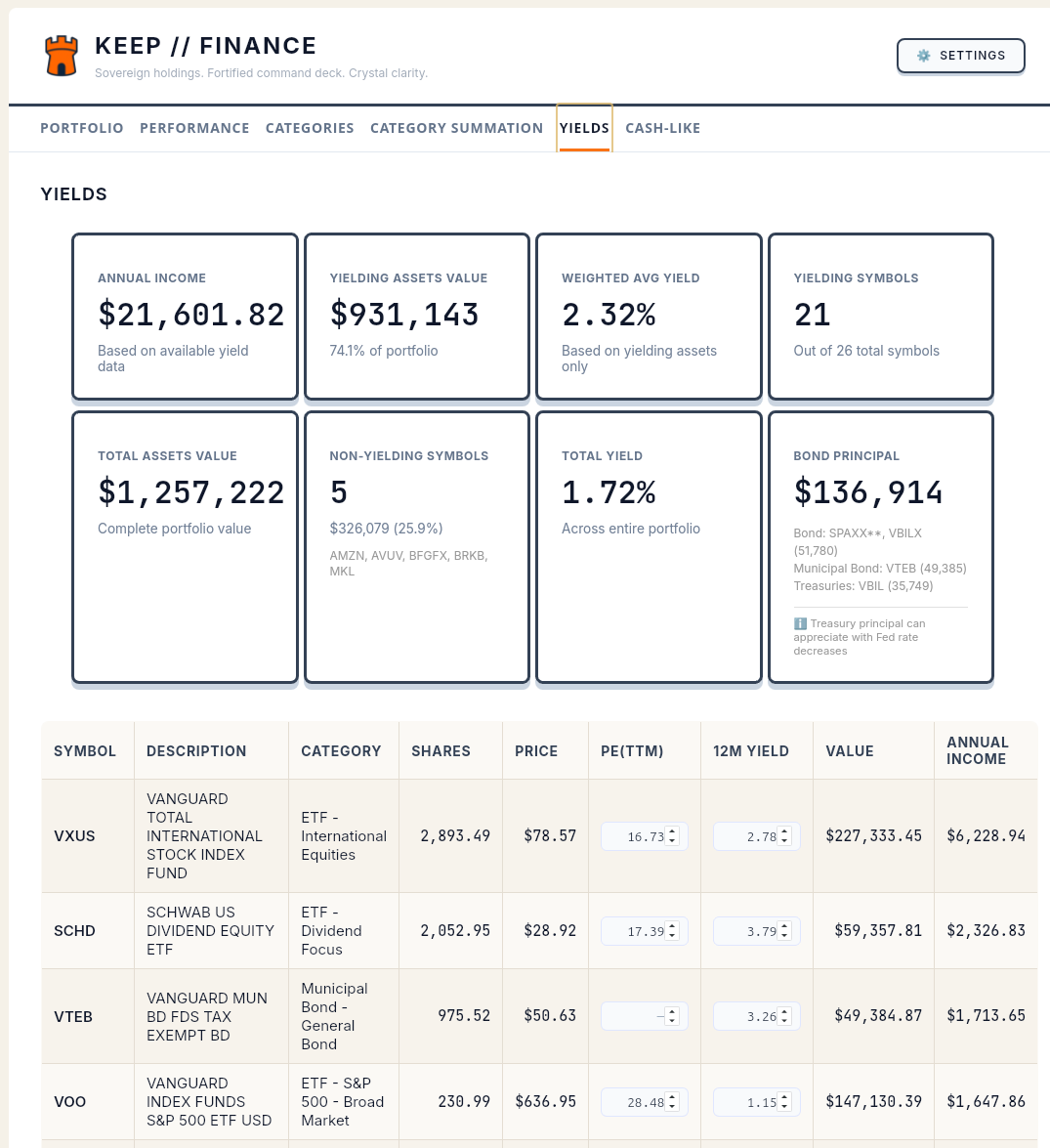
Yields & Income
The Yields view focuses on income generation across your portfolio. It highlights yielding versus non-yielding assets, weighted average yield, total estimated annual income, and bond principal exposure.
Instead of hunting through fund pages or brokerage reports, you get a consolidated, editable view of yield assumptions and income expectations in one place.
CSV-Driven, Private by Design
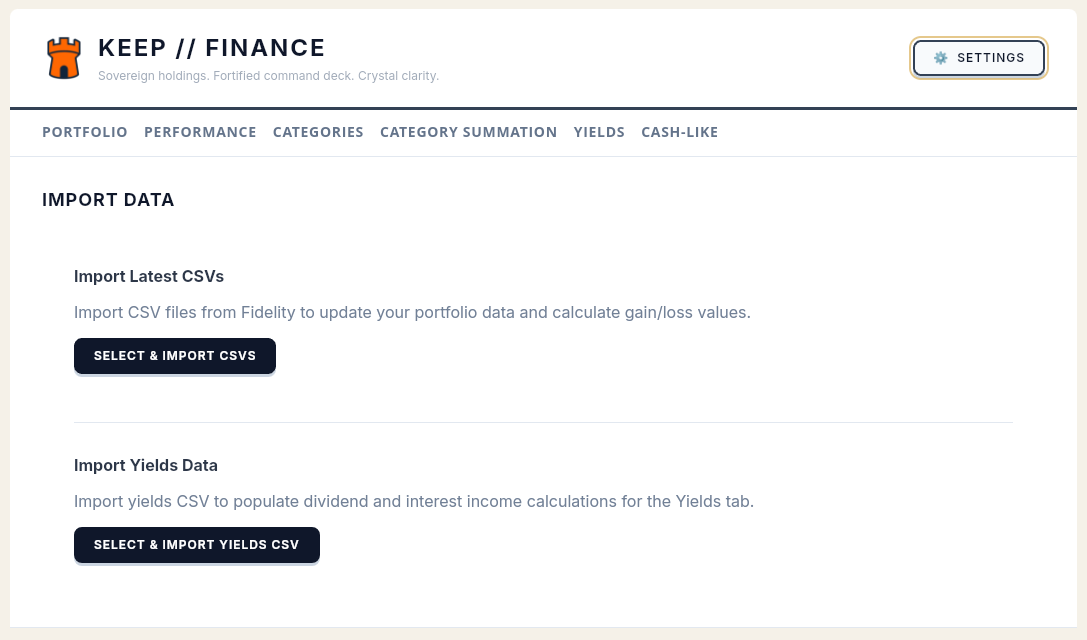
KEEP Finance is local-first and CSV-driven. You download CSV files directly from Fidelity and import them into the app — no screen scraping, no credentials stored, no third-party access to your accounts.
All calculations happen on your machine, and your financial data never leaves your control. This approach prioritizes transparency, auditability, and privacy without sacrificing analytical depth.
Your data stays yours. Always.
Why KEEP Finance Fits Nora Foundry
KEEP Finance reflects the same philosophy behind all Nora Foundry projects:
- Local-first — your data stays on your machine
- Opinionated — built for long-term investors, not traders
- Transparent — human-readable exports, no black boxes
- Respectful — no accounts, no tracking, no data harvesting
It's not built to compete with Bloomberg terminals, day-trading platforms, or automated optimizers. It's built to help you think clearly about what you own, how it's structured, and why.
Continue reading
Is KEEP right for you?
 Interact with ChatGPT to see whether KEEP fits your investing temperament →